 ZR Brand Builders // The Framework
ZR Brand Builders // The Framework
ZR Brand Builders // The Framework
How we run real brands at $100k–$140k days. The full operator playbook — positioning, validation, ad structure, retention, ops. Built in the trenches over six years, not pulled out of a course.
Everyone hunts for a winning product. The 90% that fail are looking at the wrong end of the equation. Audience first, product second, everything else stacks on top.
Market. Product. Ads. Funnel. They sit on a slider, not a list. If your product is a 10/10, mid ads and a mid funnel still print money. If your product is a 5/10, ads and funnel have to be cracked to compensate. Most operators try to fix every problem with a product change. Wrong lever, every time.
It's not the product. It's the audience. They sold to the wrong people — usually no people at all — with the wrong message at the wrong moment. If you sell to everyone, you sell to nobody.
The frame: don't look for a winning product. Look for a frustrated audience with money who has already tried other solutions that didn't work. That's the most valuable position in ecommerce. Everything else stacks on top.
Note: this video is from earlier in the year — the framework still holds, but we now run all the AI work in Claude rather than ChatGPT. Tooling shifts faster than fundamentals.
We use Claude to dig into Amazon 2-star and 3-star reviews, Reddit threads, Quora questions, and TikTok comments — pulling the language frustrated buyers actually use. We're not looking for product ideas. We're looking for the gap between what exists and what people actually need.
Use deep research to analyze the [INSERT NICHE] market. Go through Amazon reviews (3-star and 2-star specifically), Reddit threads, Quora questions, and TikTok comments related to this category. Find the top 5 recurring complaints that existing products are NOT solving well. For each complaint: write the exact language people use to describe it, estimate how frequently it appears, identify what the current solution is and why it falls short, and suggest what a product or brand would need to do or say to own that frustration. Prioritize complaints from people who have already spent money and been disappointed. I want operator-level market intelligence, not surface-level trends.
You're looking for the complaint that keeps appearing across multiple platforms, from people who already tried to solve it, where the current market response is weak, generic, or overpriced. That intersection is the gap.
A good product passes a short checklist before you ever launch an ad. Skip these and you'll find yourself fighting structural problems no creative can fix.
50% off is not an offer. It's an offer enhancer. The actual offer is the dream outcome you're selling, who you're selling it to, and how you package the whole story.
If you only remember one thing, remember this: a banger offer is the foundation. Ad creative, landing pages, retention flows — all of it lives on top of the offer. If the foundation is weak, nothing built on top of it holds up.
Use the value equation. Strong offer = high dream outcome × high believability, divided by low time delay × low effort. Optimize each variable until the customer can't say no.
Take any category — supplements, apparel, beauty, food. The brand that scales doesn't compete on price. They re-position the product so the comparison stops working.
A $60 supplement priced against a $30 competitor is dead on arrival. The same supplement positioned as "the natural alternative to a $200/month doctor's prescription" is suddenly cheap. The product hasn't changed. The category it's compared to has.
Same product. Different frame. The competition vanished because the customer is now comparing it to the wrong thing. Positioning is the act of choosing the comparison.
Before you write a single ad, build a single landing page, or design a single funnel — get inside the head of the person you're selling to. Not the demographic. The actual person. Their language, their fears, their failed attempts, their internal monologue at 11pm.
This is the upstream work that determines whether anything downstream converts. Most brands skip it and try to compensate with creative volume. Volume doesn't fix a misread avatar.
You are a direct response research analyst. For [CATEGORY / PRODUCT], harvest verbatim voice-of-customer quotes from Reddit threads, Amazon 2–3 star reviews, Quora, Trustpilot, and private Facebook groups. Collect 5–10 quotes for each priority below. Word-for-word — no paraphrase. Source URL + platform + date for every quote. P1. DEEP EMOTIONAL PAIN — the sentences they write when they're not performing. Not "I have [symptom]." The sentence that follows it. Identity grief, relational fear, professional collapse, shame. P2. DESIRE INTENSITY — bargaining language ("I would pay anything"), desperation ("I'm on the verge of..."), the specific micro-scenarios they fantasize about ("just sleeping one full night," "walking to the mailbox without stopping"). P3. BELIEF LOOPS — the unspoken sentences in their head. "Maybe it's just stress." "Maybe this is how life is now." "Maybe my doctor is right." "Maybe I'm too young/old." P4. SKEPTICISM PATTERNS — exact language they use to reject marketing. "Snake oil." "Preying on the desperate." Which proof types they call out as fake vs credible. P5. VOICE-OF-CUSTOMER DICTIONARY — exact phrases, slang, metaphors, identity labels they use when talking to each other (not to doctors, not on surveys). Output: organize by sub-segment (3–5 max). Tag every quote with sub-segment. No synthesis. No marketing copy. Raw harvest only.
Run this once per category. Save the output. Every ad, lander, and email script for the next 12 months pulls from this document.
Same product can serve completely different people. The avatar you pick determines the price you can charge, the LTV you can extract, and the CPA you have to live with.
Take a sleep supplement. Sold to anxious 25-year-olds, it's "a melatonin alternative" — competitive, low-margin, tough CPA. Same product, repositioned for stressed-out parents of newborns? It's "the 90 minutes of extra sleep that saves your marriage." Wealthier audience, longer LTV, far less price-sensitive.
Build a dedicated PDP, dedicated ads, dedicated messaging tuned to the second avatar. The product didn't change — the person buying it did. The pattern repeats across categories. Lower NCPA. Higher LTV. Often a 2–3× lift in net profit. A better avatar is worth more than a better creative.
A validated offer is not "I think this looks good." It's a 72-hour read on cold traffic with three numbers that don't lie.
Most operators waste weeks debating whether a creative is "good enough" to launch. Wrong question. The market decides what's good — not you. Your job is to put it in front of the market quickly, read the signal, and act.
Three signals. That's it. Don't overthink it.
| Signal | What it means | Action |
|---|---|---|
| Hook rate < 25% | Opening 3 seconds aren't stopping anyone scrolling | KILL |
| Hook > 25%, CTR < 1% | They watch but don't click — body or offer is off | REWRITE |
| CTR > 2%, CPA ≤ 2× target | Real signal — but don't scale yet, wait for day 3 | HOLD |
| Day 3+ at or below target CPA | Validated winner | SCALE |
End of day 3, ask one question: which 2–3 creatives produced purchases at or below target CPA? Those are winners. Cut everything else. No sentiment. No "this one looks good." The numbers decide.
People buy when they feel understood. A quiz is the fastest way to make someone feel understood at scale.
The mechanism: imagine walking into a doctor's office, sitting down, and the doctor immediately says "you have X, here's the prescription." You'd doubt it. Now imagine they take your blood pressure, ask about your symptoms, look in your ears, and then say the same thing. Total trust. The diagnosis is identical. The journey changes everything.
A 10-question quiz at the top of the funnel works because of one psychological mechanic: by the time someone has answered 10 questions about themselves, they've sold themselves. The brand is just confirming what they now believe.
The diagnosis page can route everyone to roughly the same outcome — most quiz funnels do. Doesn't matter. The sale isn't made on the diagnosis page. It's made through the act of self-diagnosis.
The product offer at the end converts 4–6× a cold PDP. The customer didn't get sold a product. They walked themselves into wanting one.
Once you have one validated avatar, the next test isn't a new product — it's a new avatar for the same product. Spin up a dedicated CBO + dedicated lander with messaging targeted to the new avatar. If CPA holds, you've found a second audience. Same product, multiplied revenue.
No testing campaigns. No scaling campaigns. No interest stacks. No lookalikes. The structure is intentionally boring, because the work is in the creative.
Default — the 20% SOP. Five minutes a day. That's the entire scaling protocol.
Surf — when momentum is real. Hook rate above 35%, CPA crushing target by 30%+, ROAS climbing day over day. That's a wave. Don't tap it for 20%. Ride it.
Most operators waste two hours a day "checking ads" and tweaking. The 5-minute SOP is enough. Fewer decisions = better decisions.
One CBO doesn't mean one type of creative. Inside the campaign, you're running three distinct jobs at once.
The biggest unlock right now is the white-label / collaboration ad. You post the ad from a creator's account with your brand as a collaborator. Native, trusted, piggybacks their audience. Most brands are running zero. It's the fastest CPA reduction available.
Three pillars: format mix, awareness coverage, landing-page mirroring. Skip any of them and you're shipping volume that won't compound. After Eugene Schwartz on the awareness model.
Rule: every weekly batch hits at least one creative per awareness stage and contains both static and video formats. If a stage is empty, that gap becomes the brief for next week's UGC partner shoot. Creatives first, landers second.
You have the strategy. Now you need the volume. With the right stack — Claude, ChatGPT Image 2.0, Higgsfield — one operator can do the work of a five-person creative team.
Most brands stay small because their creative pipeline is broken. They wait on freelancers, go back and forth on deliverables, spend $3k and get six creatives in three weeks. Meanwhile the brands scaling past them are shipping 50 ads a week.
The asymmetry is the entire game.
You are a direct response copywriter who specializes in Facebook and TikTok ads for ecommerce brands. The audience is [DESCRIBE AUDIENCE]. The core frustration we are targeting is [PASTE GAP FROM STEP 1]. The product solves this by [ONE SENTENCE MECHANISM]. Write 10 ad scripts in this exact format: Hook (first 3 seconds, spoken to camera, maximum 15 words), Problem agitation (5–8 seconds, make them feel completely understood), Solution reveal (5 seconds), Proof or reason to believe (5 seconds), CTA (3 seconds, direct and specific). Write each hook in a different emotional register: curiosity, frustration, social proof, fear of missing out, and pattern interrupt. Do not use generic ad language. Write the way a real person talks when they are genuinely frustrated.
Run this four times with slightly different problem framings. Two hours in, you have 35–40 scripts. Cut to the 10 sharpest hooks — the ones that make you stop mid-scroll when you read them out loud.
This is a starter prompt. Operators inside our community work from a deeper library — gap research, full avatar pipelines, hook generation, advertorial scaffolds, post-purchase flows. Start with what's above and you'll get 80% of the value.
Higgsfield handles cinematic product footage and lifestyle sequences. One morning of work adds 20+ high-fidelity variations to your batch — Tier-1 agency production value at near-zero cost. Use Nano Banana Pro for the photo-realistic statics.
ChatGPT Image 2.0 (in thinking mode) handles photorealistic statics with rendered text — the format that's quietly outperforming AI video right now. The workflow that ships:
Once you have a winner, replicate the angle across every format and hook variation you can generate. From one winning creative, extract 12–15 variations inside 24 hours:
80% of new creatives iterate the winning angle. 20% test brand-new angles. The 20% means your next winner is already in testing before the current one fades.
Treat the first purchase as the entry point, not the destination. Retention is where margin lives — the mechanism just looks different per category.
For consumable categories — supplements, beauty, food — subscription is the architecture. The big greens-powder brands all run the same play: subscribe is the obvious choice, one-time is intentionally worse. 50%+ off + stacked free gifts on the subscribe path. One-time purchase priced $20+ higher with no extras. The math closes the decision before the customer consciously makes it.
For non-consumable brands — apparel, accessories, lifestyle, beauty drops — subscription doesn't fit. Brands like Nuamore retain through other mechanics:
The mechanism is the same: design the post-purchase journey so the customer stays in your world. The execution differs by category.
Static popup forms are cooked. The mechanic that's working in 2026: gamified popups — Alia, Spin Wheel, Scratch Card. The user reveals their reward instead of being handed it.
Same offer. Different psychology. Earned discounts feel different from given ones — and the conversion gap is real. We've seen 2–3× lift swapping a static popup for a scratch-card flow.
Don't stack a second discount inside the popup. The acquisition offer already lives on the site. The popup gates it behind opt-in. Most brands quietly destroy their margin layering 10% off on top of an existing welcome offer.
When someone signs up after clicking your ad, they are the warmest they will ever be. Every day after, they only get colder. You have a 24–48 hour window to convert before someone else does — Meta is feeding that customer your three closest competitors the moment they click.
The cadence: 3–5 emails on day one. Daily SMS for the first two weeks. Then daily email campaigns ongoing. That sounds aggressive. It works.
The brand that wins is the one that does fewer things, more frequently, with sharper SOPs. Out-system the problem before you try to outwork it.
Most operators waste hours daily refreshing the dashboard. Five minutes is enough. The rest of the day is for building the next thing — not babysitting the current one.
D2C is volatile. Ad accounts get banned. CPMs spike. Attribution breaks. B2B is forecastable revenue with higher margins and smoother volume.
Once your brand has any presence, B2B starts falling into your lap — corporate gifting, hotels, spas, boutique retailers, subscription-box partners. It's also a marketing channel: someone sees your product in a hotel spa, sees an ad two weeks later, converts on D2C. Omnichannel compounds. Single-channel plateaus.
We're not running a course business that ran one Shopify store in 2019. The framework above is the framework we run yesterday, today, and tomorrow.
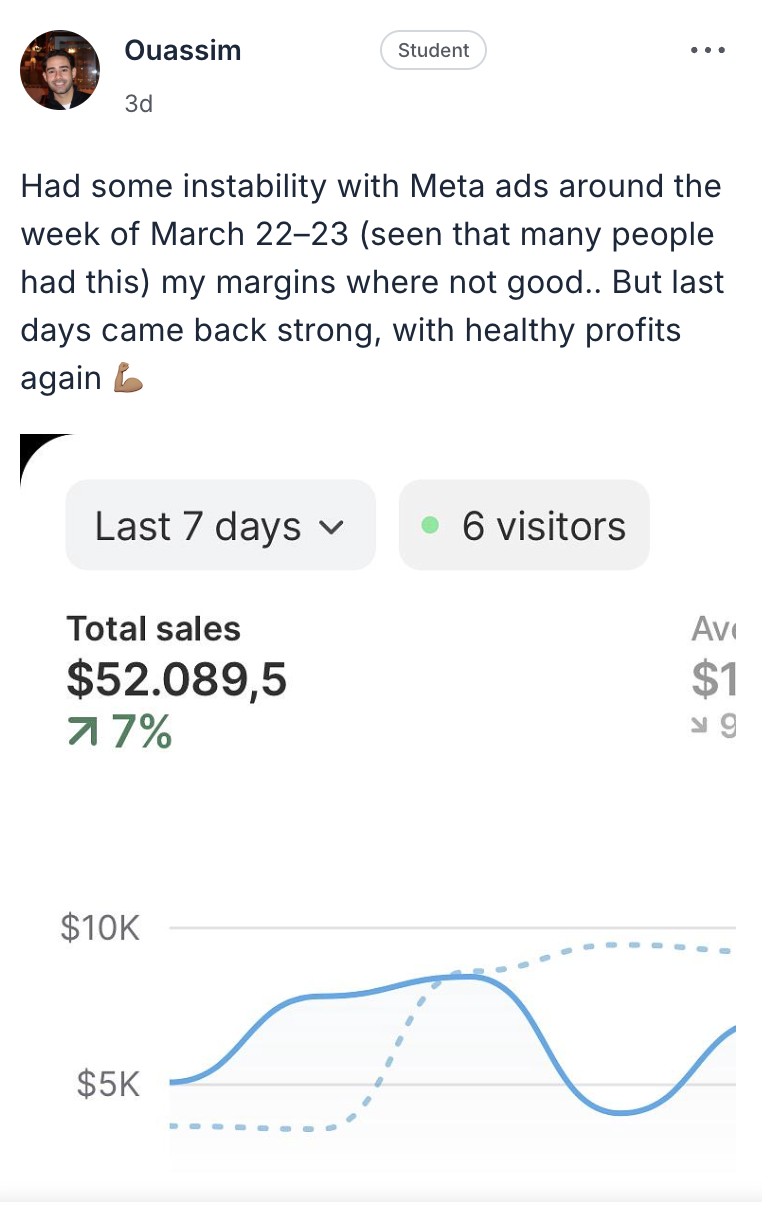
Ouassim came to us with a product and an audience but no real structure underneath it. No creative testing system. No way to diagnose what was breaking when ads went sideways.
We didn't find him a magic product. The framework made every decision faster and every test smarter. Within seven days he was running healthy profits with a system he could repeat.
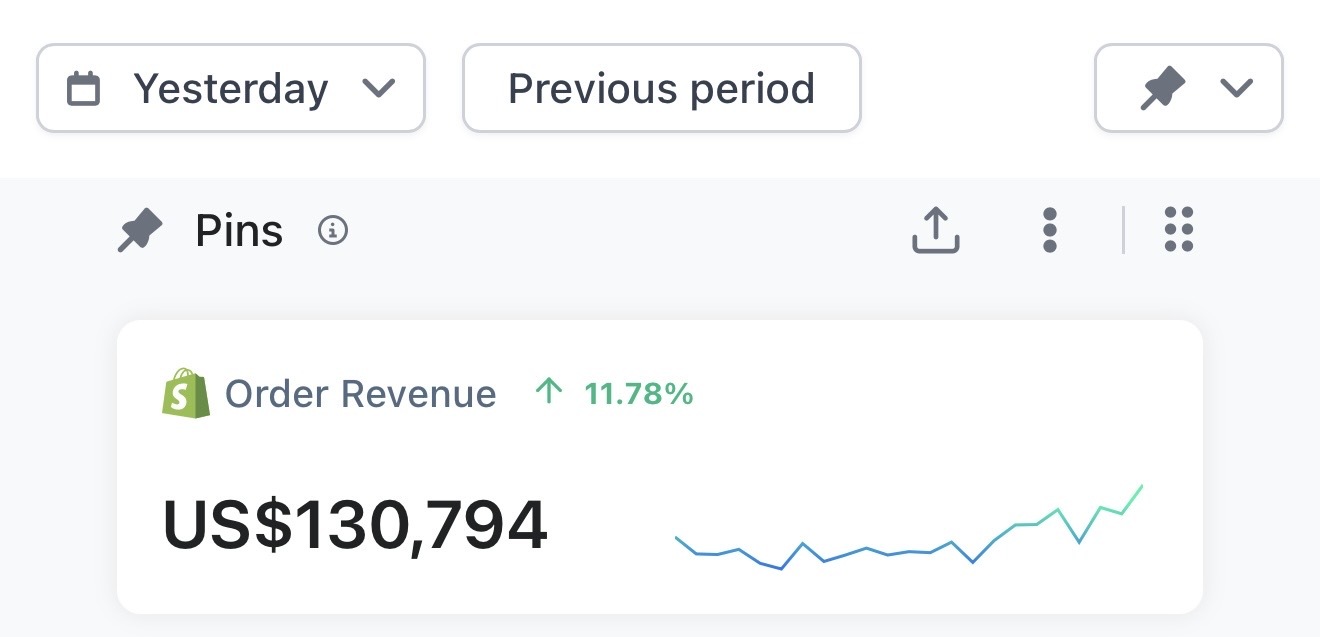
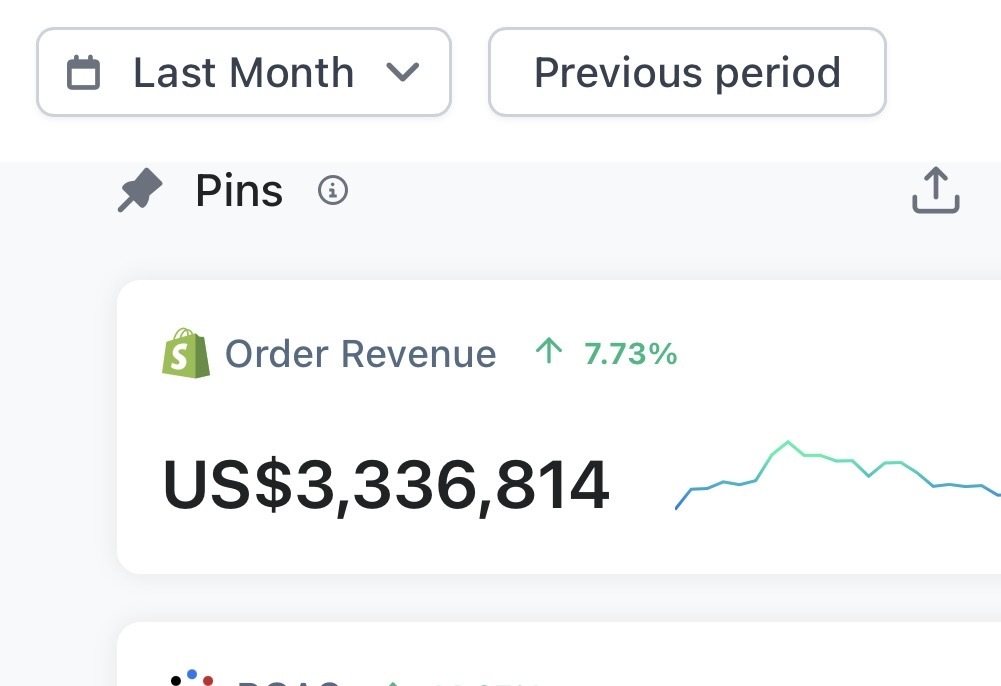
$3.3M months. $100k–$140k days. Six years operating. Real brands, real supplier problems, real ad accounts, real chargebacks. Not rented lifestyle — running operations.
Most operators read this and try to implement everything in week one. Don't. Pick the section that's most broken in your business and fix that first. The rest stacks on top.
If you want us in the operation alongside you — guiding creative strategy, launch structure, scaling decisions — we run a small 1-on-1 program. Real operations, not coaching from a distance. You're in the system live, making decisions on real brands.
Spots open by application a few times a year. We DM operators directly when a slot frees up.